Product Introduction
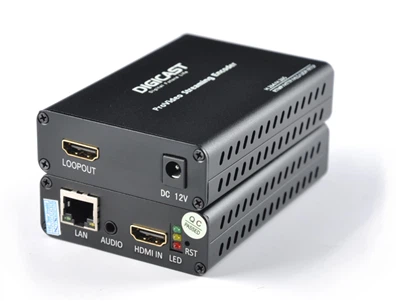
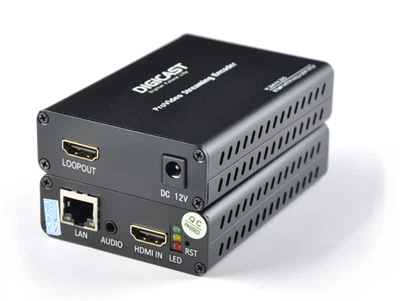
8-Channel H.265 HDMI to IP Streaming Encoder
Model: DMB-8908A-EC
Core Advantages
Portable 8‑input HDMI encoder, designed for flexible mobile deployment
Delivers Full HD 1080p resolution at 30 frames per second
Adjustable bitrate, resolution, and streaming protocol for customized output
Simple setup and easy‑to‑use operation
Maintains clear, high‑quality video even under low‑bandwidth conditions
Overview
DMB-8908A-EC features 8-channel HDMI input with embedded audio, supporting H.264/H.265 HEVC video encoding and AAC/MP3/MP2/AC3/G.711 audio encoding, with each channel capable of simultaneous dual-stream output. Its compact integration and economical design enable broad deployment in applications such as IPTV system headends and live streaming to platforms including YouTube Live, Ustream, Twitch, and Facebook Live

Features:
High-Density Design – Eight HDMI channels operate concurrently within a single compact unit.
Advanced Video Encoding – Supports H.265 HEVC, H.264 AVC, and MPEG-4 encoding formats.
Optimized Performance – Supports video compression up to 1080P@30fps, with each HDMI input capable of generating two independent IP transport streams, each configurable with distinct resolutions and bitrates.
On-Screen Display (OSD) Control – Enables real-time OSD adjustment during live streaming, including customizable logos, text, and scrolling captions.
Audio Flexibility – Compatible with multiple audio coding formats, including Dolby AC3, AAC, MP3, and MP2.
Encoding Control – Offers both Constant Bit Rate (CBR) and Variable Bit Rate (VBR) encoding modes for broadcast applications.
Audio Output Selection – Configurable audio output modes: Left channel, Right channel, or Stereo.
Protocol Support – Compatible with HLS, RTSP, HTTP, UDP, SRT, RTP, RTMP(S), and ONVIF network video protocols.
Intuitive Management – Easy to set up and operate via a user-friendly, web-based graphical interface.
Why Use HEVC Instead of H.264?
H.264 vs H.265 Comparison
| Feature | H.264 | H.265 |
|---|---|---|
| Compression Efficiency | Standard | Higher |
| Bandwidth Usage | Higher | Lower |
| Video Quality | Good | Better |
| 4K Support | Limited | Excellent |

IPTV Systems
IPTV Encoder
Live Streaming
Live Streaming Encoder
Broadcasting
Broadcast Encoder
Video Conferencing
Video Conference Encoder
Education Streaming
Education Streaming Encoder
Medical Video Transmission
Medical Video Encoder
Why Choose Digicast?
Professional Video Encoder Manufacturer
10+ Years Experience
OEM & ODM Available
CE / FCC / RoHS Certified
Technical Support
Worldwide Shipping
Frequently Asked Questions
What is a HEVC Encoder?
A HEVC Encoder, also known as an H.265 Encoder, is a device that converts video signals into H.265/HEVC compressed streams for efficient transmission and storage. HEVC (High Efficiency Video Coding) is an advanced video compression standard that delivers the same video quality as H.264 while using significantly less bandwidth. HEVC encoders are widely used in IPTV systems, live streaming, broadcasting, video conferencing, surveillance, and AV-over-IP applications.
What is the difference between H.264 and H.265?
H.264 and H.265 are both video compression standards, but H.265 (HEVC) offers much higher compression efficiency. Compared to H.264, H.265 can reduce bandwidth and storage requirements by up to 50% while maintaining similar image quality. This makes H.265 a preferred choice for high-resolution video streaming, IPTV distribution, 4K content delivery, and bandwidth-sensitive applications.
Why is HEVC better than H.264?
HEVC provides improved compression efficiency, allowing users to transmit higher-quality video using less bandwidth. It is particularly beneficial for Full HD and 4K video streaming, remote video transmission, IPTV systems, and network-based broadcasting. By reducing network load and storage costs, HEVC helps organizations achieve better video performance and lower operating expenses.
How does a HEVC Encoder work?
A HEVC Encoder captures video from an input source such as HDMI, SDI, or IP video and compresses the video using the H.265/HEVC standard. The encoded video stream can then be transmitted over IP networks using streaming protocols such as RTMP, RTSP, HTTP, UDP, or HLS. This process reduces bandwidth consumption while maintaining excellent image quality.
Does this encoder support HDMI input?
Yes. The encoder supports HDMI video input, allowing users to connect cameras, video switchers, media players, computers, and other HDMI-enabled devices. The HDMI signal is encoded into an H.265 video stream for efficient network transmission and streaming applications.
What streaming protocols are supported?
The encoder supports multiple streaming protocols commonly used in professional video distribution systems, including RTMP, RTSP, HTTP, UDP, RTP, HLS, and other network streaming formats. This flexibility allows seamless integration with IPTV platforms, streaming servers, content delivery networks, and AV-over-IP systems.
Does it support RTMP streaming?
Yes. The encoder supports RTMP (Real-Time Messaging Protocol), making it suitable for live streaming applications. RTMP support enables direct streaming to media servers, content delivery platforms, and various online broadcasting services.
Does it support RTSP streaming?
Yes. The encoder supports RTSP (Real-Time Streaming Protocol), allowing low-latency video transmission over IP networks. RTSP is commonly used in surveillance systems, IPTV deployments, AV-over-IP solutions, and professional video monitoring applications.
Can it be used for IPTV applications?
Absolutely. The HEVC Encoder is an ideal solution for IPTV systems because H.265 compression significantly reduces bandwidth requirements while maintaining excellent video quality. This makes it suitable for hotels, campuses, enterprises, cable operators, and IPTV service providers.
What video resolutions are supported?
The encoder supports high-definition video resolutions suitable for professional broadcasting and streaming applications. Depending on the model, it may support resolutions up to Full HD 1080P or higher. Please refer to the product specifications for detailed resolution support information.
What is the encoding latency?
The encoder is optimized for low-latency video encoding to ensure smooth real-time video transmission. Actual latency depends on encoding settings, network conditions, video resolution, and streaming protocols. In most professional applications, the encoder delivers reliable low-delay performance suitable for live events, IPTV, and AV-over-IP systems.
Can it stream to YouTube and Facebook Live?
Yes. If RTMP streaming is enabled, the encoder can be configured to stream directly to popular live streaming platforms such as YouTube Live, Facebook Live, Twitch, and other RTMP-compatible services. This makes it a versatile solution for content creators, broadcasters, and live event producers.
Can it be integrated into existing AV systems?
Yes. The encoder is designed for easy integration into existing AV infrastructures. It can work alongside video switchers, IPTV systems, digital signage networks, streaming servers, conference systems, and AV-over-IP platforms, providing a flexible and scalable video distribution solution.
Is OEM or ODM customization available?
Yes. We offer both OEM and ODM services for customers worldwide. Customization options may include logo branding, firmware modification, protocol customization, user interface design, packaging customization, and hardware adjustments to meet specific project requirements.
What industries use HEVC encoders?
HEVC encoders are widely used in IPTV broadcasting, live streaming, television broadcasting, video conferencing, distance learning, healthcare, government projects, digital signage, security monitoring, houses of worship, enterprise communication systems, and AV system integration. Their high compression efficiency makes them suitable for any application that requires reliable, high-quality video transmission over IP networks.
Hot Tags: HEVC H.265 Video Encoder | HDMI Live Streaming Encoder, China HEVC H.265 Video Encoder | HDMI Live Streaming Encoder manufacturers, suppliers, factory, rackmount video encoder, 8k video encoder, wireless video encoder, vp9 video encoder, hdmi encoder, secam video encoder
Specifications
Video Input
Video compression: H.265 HEVC / H.264 AVC
Frame rate: up to 1080P@30fps (Recommended to be setup under the max. capability of 8CH@30fps or 4CH@60fps+4CH@30fps)
Video input: 8*HDMI (HDCP compatible)
Resolution:
Main stream:
1920x1080,1680x1056,1280x720,1024x576,850x480,720x576,720x540,720x480,720x404,704x576,640x480, 640x360, auto.
Second Stream:
1280x720,1024x576,850x480,720x576,720x540,720x480,720x404,704x576,640x480,640x300,352X288,320X240,320X180 auto.
Bit-rate: 16kbps~32Mbps, CBR/VBR
Video pre-processing: Noise reduction, Sharpen, Filtering
Audio Encoding
Audio compression: AAC,AAC+,AAC++,MP3,MP2,Dolby Digital AC-3
Audio input: 8*HDMI embedded
Sampling accuracy: 24-bit
Bit Rate: 48kbps~320kbps
Sample-rate: 44.1KHz, 48KHz
IP Streaming output
Transport protocol: TS over IP output, HLS, RTSP, HTTP, UDP and RTMP protocol.
For each HDMI to IP output, supporting output 2 groups TS over IP streams (for each group the HLS, HTTP, RTSP, UDP and RTMP protocol all enabled) with 2 different resolutions (up to 1080p) and 2 different bitrates to meet different size screen and different bandwidth condition.
Connector: RJ45, 1000M.
General Options
Physical and Power
Voltage: 12V
Consumption: less than 20W
Operating temperature: 0~45℃(operation), -20~65℃(storage)
Dimensions: 30cm(W)*16cm(D)*7cm(H)
Weight: 2Kg/pc
Applications
Digital TV Broadcasting System
IPTV & OTT system
Internet TV
Remote Video Conference
Live Streaming