


In the ever - evolving landscape of video technology, the demand for high - quality video content has skyrocketed. 4K resolution, with its stunning clarity and immersive viewing experience, has become the standard for many professional and consumer applications. As a 4K encoder supplier, I am often asked whether a 4K encoder can be integrated with other video equipment. The answer is a resounding yes, and in this blog, I will explore the details of such integrations.
Understanding 4K Encoders
Before delving into integration possibilities, it's essential to understand what a 4K encoder does. A 4K encoder is a device that compresses high - resolution 4K video signals into a more manageable format for storage, transmission, or streaming. This compression is crucial because 4K video contains a vast amount of data, and without encoding, it would be challenging to handle due to bandwidth limitations and storage requirements.
4K encoders use various encoding algorithms such as H.264 and H.265 (HEVC). H.265, in particular, offers better compression efficiency than H.264, allowing for higher - quality video at lower bitrates. This is beneficial when streaming 4K content over the internet, as it reduces the required bandwidth while maintaining excellent visual quality. For more information on our 4K encoders, you can visit our 4k Streaming Encoder page.
Integration with Video Cameras
One of the most common integrations is between a 4K encoder and a 4K video camera. Many professional video production setups now use 4K cameras to capture high - quality footage. Once the footage is captured, it needs to be encoded for further processing, storage, or live streaming.
Modern 4K cameras often have outputs such as HDMI or SDI (Serial Digital Interface). A 4K encoder can be connected to these outputs to receive the raw 4K video signal. For example, in a live sports event, a 4K camera can be placed in the stadium to capture the action. The camera's SDI output can be directly connected to a 4K encoder. The encoder then compresses the video signal and can send it to a streaming server or a recording device. This integration allows for seamless transfer of high - quality video from the camera to the next stage of the production process.
Integration with Video Switchers
Video switchers are used in multi - camera setups to select different camera feeds and create a single output. Integrating a 4K encoder with a video switcher is essential for live events such as concerts, conferences, and theatrical performances.
The video switcher combines multiple 4K camera signals and outputs a single 4K video stream. The 4K encoder can be connected to the output of the video switcher. Once connected, the encoder compresses the combined video signal. This compressed signal can then be sent to a streaming platform or a broadcast network. For instance, in a large - scale corporate conference, several 4K cameras may be placed around the venue to capture different angles. A video switcher selects the appropriate camera feed based on the event's flow, and the 4K encoder ensures that the final output can be efficiently transmitted to remote viewers.
Integration with Streaming Servers
Streaming servers play a vital role in delivering 4K video content to viewers over the internet. A 4K encoder can be integrated with a streaming server to enable live 4K streaming.
The encoder compresses the 4K video signal and sends it to the streaming server using protocols such as RTMP (Real - Time Messaging Protocol) or SRT (Secure Reliable Transport). The streaming server then distributes the compressed video to viewers' devices. This integration is crucial for platforms like YouTube Live, Twitch, and other live - streaming services that offer 4K content. For example, a gaming streamer who wants to broadcast their gameplay in 4K can use a 4K encoder to compress the video from their gaming PC. The encoder sends the compressed video to a streaming server, which then makes the content available to the streamer's audience.
Integration with Video Storage Devices
Storing 4K video content requires a significant amount of storage space. A 4K encoder can be integrated with video storage devices to reduce the storage requirements.
The encoder compresses the 4K video before it is stored on a hard drive, a network - attached storage (NAS) device, or a cloud storage service. This compression not only saves storage space but also makes it easier to manage and transfer the video files. For example, a video production company that shoots a lot of 4K footage can use a 4K encoder to compress the videos before archiving them on a NAS device. This way, they can store more content in the same amount of storage space.
Technical Considerations for Integration
While integrating a 4K encoder with other video equipment is possible, there are several technical considerations.
Compatibility: Ensure that the input and output interfaces of the 4K encoder are compatible with the other video equipment. For example, if the camera has an HDMI output, the encoder should have an HDMI input.
Bandwidth: When streaming 4K video, the available bandwidth is a crucial factor. The encoder should be able to adjust the compression settings based on the available bandwidth to ensure smooth streaming.
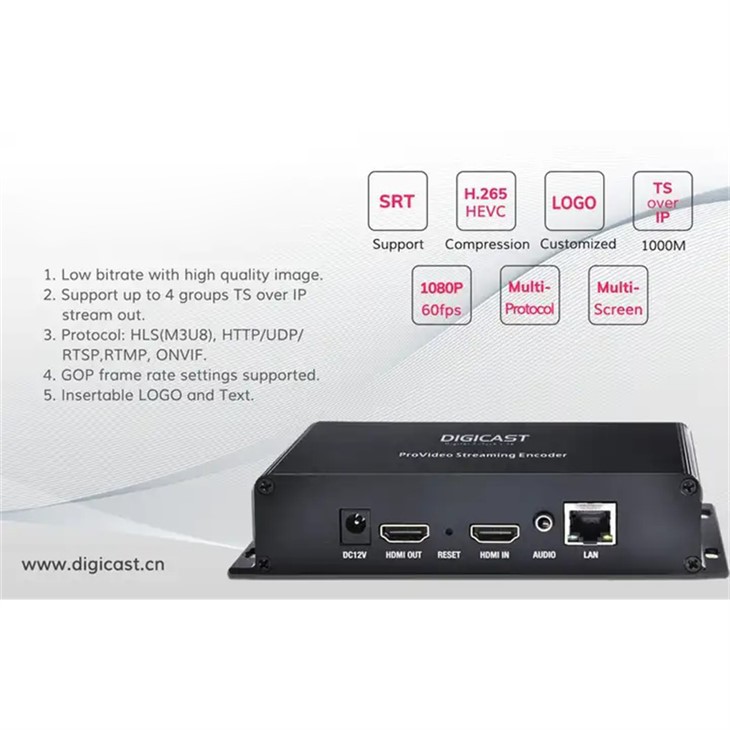

Latency: In live - streaming applications, low latency is essential. The encoder should be able to compress the video with minimal delay to ensure that the viewers experience real - time action.
Benefits of Integration
Integrating a 4K encoder with other video equipment offers several benefits.
Cost - Efficiency: By using a single 4K encoder to compress video from multiple sources, production costs can be reduced. Instead of having separate encoding solutions for each piece of equipment, a single encoder can handle the entire video stream.
Quality Assurance: A 4K encoder ensures that the video quality remains high throughout the production and distribution process. It can optimize the compression settings to maintain the best possible visual quality.
Flexibility: Integration allows for more flexible video production setups. For example, in a mobile production unit, a 4K encoder can be easily connected to different cameras, switchers, and streaming servers, enabling on - the - go 4K video production.
Conclusion
As a 4K encoder supplier, I can attest to the fact that a 4K encoder can be effectively integrated with various other video equipment. Whether it's a camera, a video switcher, a streaming server, or a storage device, the integration possibilities are vast. These integrations offer numerous benefits in terms of cost - efficiency, quality assurance, and flexibility.
If you are in the market for a 4K encoder and are interested in exploring integration options for your video equipment, I encourage you to reach out to us. Our team of experts can provide you with detailed information and guidance on how to integrate our 4K encoders with your existing or planned video setup. We look forward to discussing your specific requirements and helping you achieve the best 4K video production and distribution results.
References
- "Video Encoding for Dummies" by Mark Goodman.
- "The Handbook of Video and Image Processing" edited by Thomas S. Huang and Wen - High Cheng.
- Industry whitepapers on 4K video technology from leading manufacturers.