


In the era of high - definition visual experiences, 4K technology has emerged as a game - changer, revolutionizing the way we consume and produce video content. As a leading 4K encoder supplier, I am excited to delve into the main functions of a 4K encoder and how it can elevate your video production and streaming capabilities.
High - Resolution Video Compression
One of the primary functions of a 4K encoder is to compress high - resolution 4K video content. 4K video, with its 3840×2160 or 4096×2160 pixel resolution, contains an enormous amount of data. Uncompressed 4K video requires an extremely high - bandwidth storage and transmission system, which is often impractical and costly.
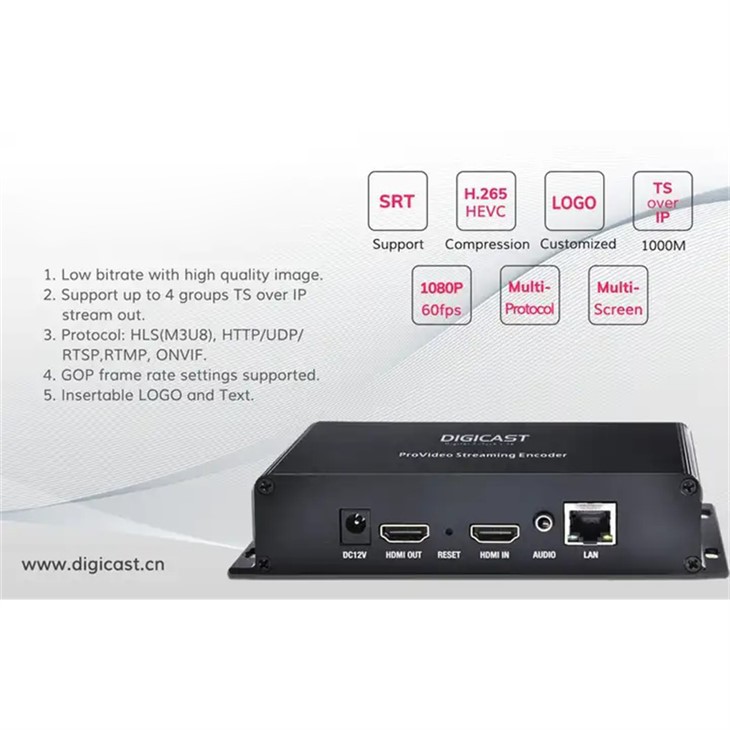
A 4K encoder uses advanced compression algorithms such as H.264 and H.265 (HEVC). These algorithms analyze the video frames, identify redundant information, and then compress the video without significant loss of quality. For example, H.265 can achieve up to twice the compression ratio of H.264, which means you can store and transmit 4K video with much less bandwidth. This is crucial for applications like online video streaming, where bandwidth is a limited resource. If you are looking for a high - performance 4K encoder for streaming, you can check out our 4k Streaming Encoder.
Format Conversion
Another important function is format conversion. Different devices and platforms support various video formats. A 4K encoder can convert 4K video from one format to another, ensuring compatibility across different systems. For instance, some professional video cameras record in proprietary formats, which may not be directly playable on common media players or streaming platforms.
The encoder can convert these formats into more widely recognized ones like MP4, MOV, or FLV. This flexibility allows content creators to reach a broader audience. Whether you are a filmmaker looking to distribute your 4K movie on multiple platforms or a live event organizer wanting to stream the event in 4K to different devices, format conversion is essential.
Multi - Channel Encoding
Many modern 4K encoders support multi - channel encoding. This means they can encode multiple video streams simultaneously. In a live event scenario, such as a sports game or a concert, you may want to provide different camera angles or perspectives to the viewers. A multi - channel 4K encoder can encode each camera feed separately and stream them concurrently.
This feature also enables the creation of multi - view video experiences. For example, in a corporate training session, different presenters or demonstration areas can be encoded as separate channels, and the viewers can switch between them according to their needs. Multi - channel encoding not only enhances the viewer experience but also increases the efficiency of video production and distribution.
Real - Time Encoding
Real - time encoding is a critical function, especially for live events. In live streaming, there is no room for delay. A 4K encoder must be able to encode the incoming 4K video in real - time and send it to the streaming server immediately. This requires high - speed processing capabilities and optimized algorithms.
Our 4K encoders are designed with powerful processors and advanced encoding algorithms to ensure smooth real - time encoding. Whether it's a live news broadcast, a live e - sports tournament, or a live webinar, real - time encoding guarantees that the audience can watch the event as it happens without any significant lag.
Metadata Insertion
Metadata provides additional information about the video content, such as the title, description, keywords, and copyright information. A 4K encoder can insert metadata into the encoded video. This is important for video management, searchability, and legal compliance.
For example, on video sharing platforms, metadata helps users find the relevant 4K videos more easily. It also allows content owners to protect their intellectual property by including copyright information. When distributing 4K video content, proper metadata insertion can improve the visibility and traceability of the content.
Video Enhancement
Some 4K encoders come with video enhancement features. These features can improve the visual quality of the 4K video. For example, they can adjust the color saturation, contrast, and brightness of the video frames. In low - light or poorly lit shooting conditions, the encoder can enhance the details and make the video more visually appealing.
Video enhancement can also include noise reduction. In some cases, the original 4K video may contain noise due to the camera's sensor or the shooting environment. The encoder can analyze the video and reduce the noise without affecting the important details, resulting in a cleaner and more professional - looking video.
Integration with Other Systems
A good 4K encoder should be able to integrate with other systems in the video production and distribution workflow. It can be integrated with video cameras, streaming servers, content management systems (CMS), and video analytics tools.
For example, integration with a video camera allows for seamless capture and encoding. When integrated with a streaming server, the encoder can send the encoded 4K video directly to the server for distribution. Integration with a CMS enables easy management and storage of the 4K video content. And integration with video analytics tools can provide valuable insights into the viewership, such as the number of viewers, their geographical locations, and the duration of their viewing.
Security Features
Security is a major concern in the digital age, especially when it comes to 4K video content. A 4K encoder can offer security features such as encryption. Encryption protects the 4K video from unauthorized access and piracy during transmission and storage.
It uses advanced encryption algorithms to scramble the video data, and only authorized users with the decryption key can access the content. This is crucial for protecting sensitive or high - value 4K video content, such as corporate training videos, premium sports events, or exclusive movie releases.
Scalability
As your video production and distribution needs grow, scalability becomes an important factor. A scalable 4K encoder can handle increasing amounts of video data and support more users without significant performance degradation.
Our 4K encoders are designed to be scalable. Whether you are starting a small - scale 4K video streaming project or planning to expand to a large - scale enterprise - level operation, our encoders can adapt to your changing requirements.

In conclusion, the functions of a 4K encoder are diverse and essential for modern video production and distribution. From high - resolution compression to real - time encoding, format conversion, and security features, a 4K encoder plays a crucial role in delivering high - quality 4K video content. If you are interested in upgrading your video capabilities with a reliable 4K encoder, we invite you to contact us for procurement and further discussion. Our team of experts is ready to help you find the best solution for your specific needs.
References
- "Video Compression: Principles and Practice" by David S. Taubman and Micheal W. Marcellin.
- "Digital Video Broadcasting: Technology and Standards for Next - Generation Television" by John Vince.
- Industry reports on 4K video technology and market trends.