


The dynamic range of an EDFA (Erbium Doped Fiber Amplifier) is a critical parameter that significantly influences its performance and suitability for various optical communication applications. As a leading supplier of EDFA amplifiers, understanding and effectively communicating the concept of dynamic range is essential for our customers to make informed decisions.
Understanding EDFA Amplifiers
Before delving into the dynamic range, it's important to briefly understand what an EDFA amplifier is. An EDFA is an optical amplifier that uses erbium-doped fiber as the gain medium. It operates in the C-band (1530 - 1565 nm) and L-band (1565 - 1625 nm) of the optical spectrum, which are the most commonly used wavelength ranges for long-haul and high-capacity optical communication systems.
The basic principle of an EDFA involves pumping the erbium-doped fiber with a high-power laser at a specific wavelength (usually 980 nm or 1480 nm). This pumping process excites the erbium ions in the fiber, creating a population inversion. When an input optical signal passes through the erbium-doped fiber, stimulated emission occurs, causing the signal to be amplified without the need for optical-to-electrical conversion.
What is Dynamic Range?
The dynamic range of an EDFA amplifier refers to the range of input optical power levels over which the amplifier can operate effectively while maintaining acceptable performance specifications. It is typically defined as the difference between the maximum and minimum input power levels that the amplifier can handle.
The minimum input power level is determined by the noise figure of the amplifier. The noise figure represents the amount of noise added by the amplifier to the input signal. As the input power decreases, the signal-to-noise ratio (SNR) deteriorates, and at a certain point, the noise becomes significant enough to degrade the performance of the system. Therefore, the minimum input power is usually specified as the power level at which the SNR falls below an acceptable threshold.
On the other hand, the maximum input power level is limited by the saturation output power of the amplifier. When the input power exceeds a certain level, the amplifier reaches saturation, and the gain starts to decrease. This is because the number of excited erbium ions available for stimulated emission becomes limited, and the amplifier can no longer provide additional gain. Operating the amplifier beyond its saturation point can lead to distortion of the output signal and a decrease in the overall system performance.
Importance of Dynamic Range in Optical Communication Systems
The dynamic range of an EDFA amplifier is crucial in optical communication systems for several reasons:
Signal Integrity
In a real-world optical network, the input power levels of optical signals can vary significantly due to factors such as fiber losses, splices, and the number of optical components in the path. A wide dynamic range allows the EDFA to amplify signals with different power levels without introducing excessive noise or distortion, ensuring the integrity of the transmitted data.
System Flexibility
A wide dynamic range provides greater flexibility in system design and operation. It allows the EDFA to be used in a variety of applications and network topologies, accommodating different input power levels and signal requirements. This flexibility is particularly important in long-haul and multi-span optical networks, where the power levels can vary over a wide range.
Cost-Effectiveness
By having a wide dynamic range, a single EDFA amplifier can be used to amplify signals with different power levels, eliminating the need for multiple amplifiers or additional optical components. This reduces the overall cost and complexity of the optical communication system.
Factors Affecting the Dynamic Range of an EDFA Amplifier
Several factors can affect the dynamic range of an EDFA amplifier:
Pump Power
The pump power is one of the most important factors influencing the dynamic range. Increasing the pump power can increase the gain and the saturation output power of the amplifier, thereby expanding the dynamic range. However, there is a limit to the pump power that can be used, as excessive pump power can lead to other issues such as increased noise and fiber damage.

Erbium-Doped Fiber Length
The length of the erbium-doped fiber also affects the dynamic range. A longer fiber can provide higher gain, but it also increases the noise figure and the saturation effects. Therefore, the length of the erbium-doped fiber needs to be optimized to achieve the desired dynamic range.
Input Signal Wavelength
The dynamic range of an EDFA amplifier can vary depending on the input signal wavelength. Different wavelengths have different absorption and emission characteristics in the erbium-doped fiber, which can affect the gain and the saturation output power. Therefore, the dynamic range needs to be specified for different wavelength ranges.
Our EDFA Amplifiers and Their Dynamic Range
At our company, we offer a wide range of EDFA amplifiers with different dynamic range specifications to meet the diverse needs of our customers. Our EDFA Fiber Amplifier is designed to provide high gain, low noise, and a wide dynamic range, making it suitable for a variety of optical communication applications.
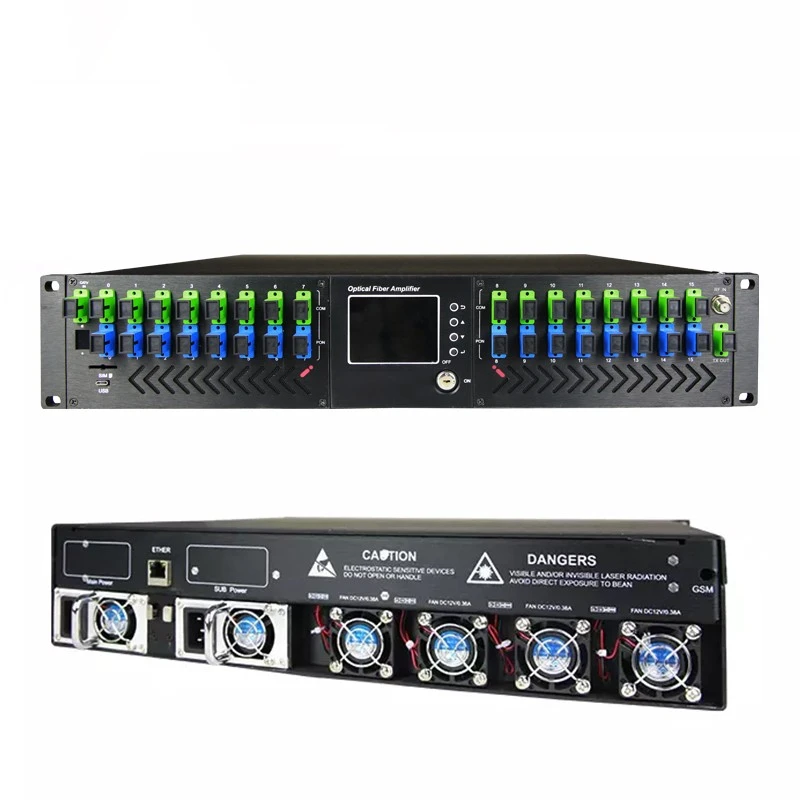
For applications that require a higher number of input channels, we also offer the 16 Port Erbium Doped Fiber Amplifier. This amplifier provides a wide dynamic range for each port, allowing it to handle multiple input signals with different power levels simultaneously.
Conclusion
The dynamic range of an EDFA amplifier is a critical parameter that determines its performance and suitability for optical communication systems. A wide dynamic range ensures signal integrity, system flexibility, and cost-effectiveness. As a leading supplier of EDFA amplifiers, we are committed to providing our customers with high-quality products that offer excellent dynamic range and other performance specifications.
If you are interested in learning more about our EDFA amplifiers or would like to discuss your specific requirements, please feel free to contact us. Our team of experts is ready to assist you in finding the best solution for your optical communication needs.
References
- Agrawal, G. P. (2002). Fiber-Optic Communication Systems. John Wiley & Sons.
- Olshansky, R. (1981). "Fundamentals of optical fiber communications." Proceedings of the IEEE, 69(10), 1212-1227.
- Ramaswami, R., & Sivarajan, K. N. (2009). Optical Networks: A Practical Perspective. Morgan Kaufmann.